
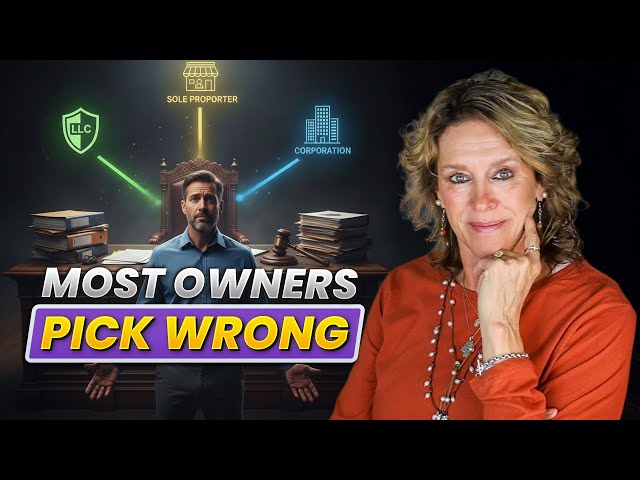
Launching a business today is more accessible than ever, but building a business that lasts requires strategy, structure, and an understanding of how to legally and financially protect what you’re working so hard to create. One of the most misunderstood yet most impactful decisions entrepreneurs make early on is choosing the correct business entity.
Whether you’re transitioning from a W-2 job into entrepreneurship, scaling an existing operation, or looking to optimize how you earn and pay taxes, the business structure you select can shape your financial future for years to come.
This article breaks down the key insights from a recent deep-dive discussion on LLCs, S Corporations, and C Corporations. It explains why choosing the right one isn’t just a legal decision but a wealth-building strategy.
Why Entity Structure Is One of the Most Important Decisions You’ll Make
The idea of “just getting started” as a sole proprietor may seem simple. Still, it’s often the most expensive mistake new business owners make.
A sole proprietorship is easy to set up, and that’s the problem.
No liability protection.
No separation between you and your business.
No strategic tax planning opportunities.
If someone sues your business, they are suing you personally. That means your home, retirement accounts, and personal assets could all be at risk.
Even low-risk businesses, like personal trainers and dog groomers, deal with clients who can get upset, feel wronged, or pursue legal action. Liability is everywhere, and pretending it isn’t is not a strategy.
The correct entity protects your assets, lowers your taxes, improves your credibility, and positions you for long-term growth.
What Are Your Real Options? Understanding the Big Three
In the U.S., most entrepreneurs decide between three main structures:
1. LLC (Limited Liability Company)
A foundational structure for small businesses. An LLC offers liability protection and flexible taxation, but its tax treatment depends on how you set it up.
Too many people click buttons on cheap filing websites without understanding the consequences. LLCs pay taxes as:
- Sole proprietorship (default)
- Partnership
- S Corporation (if elected)
- C Corporation (if elected)
Tax classification determines everything, from your income taxes to your payroll taxes, how you pay yourself, and which strategies you can leverage.
2. S Corporation (S Corp)
One of the most powerful entities for small and mid-sized business owners.
S Corps allow you to:
- Pay yourself a small W-2 salary
- Distribute the rest of the profits without paying self-employment tax
- Hire your children legally and strategically
- Unlock additional tax deductions
- Participate in more sophisticated tax planning opportunities
But S Corps only make sense once your business has consistent profit and cash flow.
Salary must be “reasonable,” but in this framework, “reasonable” means the lowest legally defensible wage, not the market rate.
3. C Corporation (C Corp)
The C Corp is the heavyweight structure that big companies use and the model that growing entrepreneurs often scale into.
A C Corp allows:
- Unlimited growth
- Multiple classes of stock
- More favorable compensation strategies
- Massive tax planning options
- Credibility with banks, investors, and partners
However, it also adds complexity and a new corporate tax layer. For many entrepreneurs, a C Corp becomes the endgame once revenues and operations justify it.
Why Tax Strategy Is Not Optional: It’s a Wealth Strategy
Most business owners overpay taxes not because they earn too much, but because they don’t plan.
There are 81,000+ pages of tax code in the U.S., and they exist to reward business owners and investors, not employees.
Yet too many entrepreneurs are:
- Filing their own taxes
- Relying on basic accountants
- Missing deductions
- Ignoring entity strategy
- Paying unnecessary self-employment taxes
- Treating their business like a hobby instead of a financial engine
A qualified tax strategist, not just a preparer, can help you move legally, ethically, and strategically into lower tax brackets.
People earning six figures routinely reduce their taxable income into the teens or even single digits by using the proper structure and the correct deductions.
Entity Structure Is Not Just About Taxes, It’s About Wealth
In every wealthy household, two core assets appear repeatedly:
1. A business
2. Real estate
Your entity structure lays the foundation for both.
An S Corp or LLC allows you to establish clean financials, business credit, multiple income streams, and the infrastructure needed to expand operations. A C Corp eventually becomes the parent structure that organizes your ventures under one umbrella.
This is the framework the wealthy use. This is the framework anyone can use.
Why You Should Never Rely Only on Social Media Followers
Another insight from the conversation was the importance of building a database, an internal list of leads, customers, and prospects.
Followers don’t belong to you.
Subscribers don’t belong to you.
Only your database is yours.
A business and a database are the two engines that every entrepreneur should build immediately.
How to Get Set Up the Right Way
Once you form your entity, you still need the whole structure:
- Operating agreement (LLC) or shareholder agreement (S/C Corp)
- EIN
- Business bank account
- Corporate credit cards
- Vendor relationships
- Bookkeeping
- Tax strategy
- Compliance calendar
Most entrepreneurs skip half these steps, then wonder why banks deny them funding or why they can’t get clean financials.
If you want your business to behave like a business, you must treat it like one.
The Biggest Mistakes Entrepreneurs Make When Choosing an Entity
- Starting as a sole proprietor
- Letting LegalZoom or cheap filing services determine their structure
- Not consulting a tax strategist before choosing a tax classification
- Paying themselves too much salary in an S Corp
- Mixing personal and business finances
- Not forming a C Corp once the business is ready
- Failing to set up corporate credit early
Each mistake can cost tens of thousands over time or worse, expose personal assets to lawsuits.
Why You Should Start Early, Even Younger Than You Think
One powerful point raised:
Teaching financial literacy and business structure early sets the foundation for generational wealth.
Suppose an 18-year-old can start an entity, learn corporate credit, build assets, and operate like a business owner. In that case, their financial trajectory can be radically different.
Wealth doesn’t come from talent or luck; it comes from strategy.
Final Thoughts: Start Your Business Like You Plan to Succeed
Entrepreneurs often make business structure decisions in a rush, with little guidance, and with no long-term planning.
But if you want to build:
- A financially efficient company
- A legally protected operation
- A scalable business
- A wealth-building machine
You need to choose your entity deliberately, not by accident.
The proper structure isn’t just paperwork; it’s the cornerstone of your financial legacy.