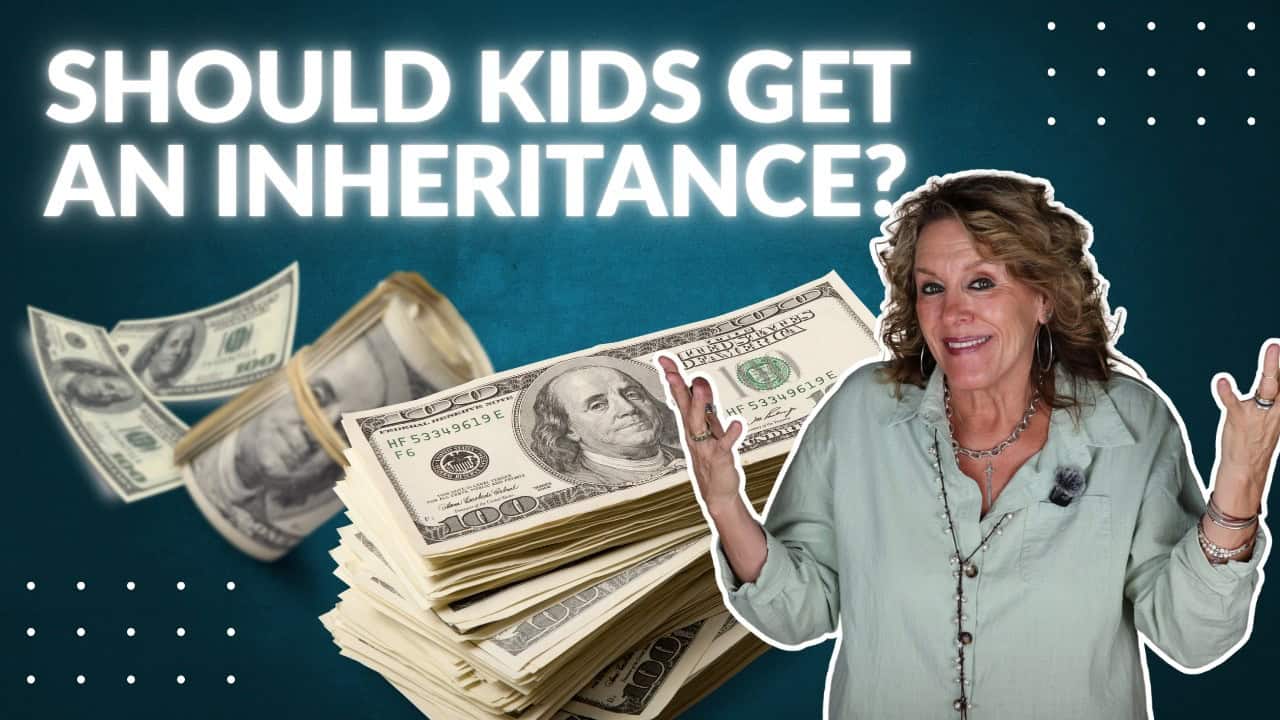
Should you leave your kids an inheritance? I get this question all the time. Usually it comes from people who’ve built something real and finally ask the scary question: who gets all of this when I’m gone?
My honest answer: that’s your decision. Not mine.
But I hope you can do it with your eyes open. When you hand kids money with no rules and no engagement, it almost always backfires. You create a trust fund baby.
Here’s the statistic I want you to sit with. Family wealth typically lasts about 2.3 generations. That means your grandkids will most likely blow it.
The wealthy don’t leave that to chance. They don’t give their kids the money. They give them the machine.
An Inheritance Is Money. A Legacy Is the Machine.
Most people use “inheritance” and “generational wealth” like they mean the same thing. They don’t.
An inheritance is the money and the stuff: the house, the accounts, the painting, the business.
Generational wealth has two parts. The inheritance is one. The legacy is the other: the roots, the wings, the character. Your kids understand what they’ll receive, why they’ll receive it, and how it all works.
In Wealth Cycle Investing, I wrote a whole chapter on the next generation, and I said it plainly. These little people don’t need your money. What they need is your knowledge.
That’s still true. So the real question isn’t how much you leave. It’s this: WHAT do you want and WHO do you want your kids to be at the end?
“Your kids don’t need your money. They need your knowledge.”
Why a Will Alone Sets Your Family Up to Fight
Many people think a will covers everything. It doesn’t.
If your assets sit only in a will, not in a trust, your estate goes through probate. And anyone can contest a will. An ex-spouse. Someone you promised a house or a painting 15 years ago. They can show up after your death and make it a mess.
I have clients stuck in one probate case for more than 35 years. The kids fought. Now the grandkids fight.
Here in northern Nevada, I’ve watched a couple of billionaire families break apart. Golf courses, casinos, huge farmlands, beef packing plants, all getting carved up. One big estate is easier to manage than a pile of pieces. Those families lost that.
Blended families raise the stakes even higher. If one spouse built the wealth before the marriage, you’d better come into that marriage clear. I work with families where stepkids sue for a share because “mom and dad were married.” That’s why I’m a massive fan of prenuptials and trusts that hold each family’s wealth independently and responsibly.
Even if you’ve only built $50,000 to $100,000, talk to an estate attorney about a trust. Without one, you’re headed for probate.
“One big estate manages better than a pile of pieces.”
The Surprise Basket Is Not a Plan
I call it the surprise basket. You tell nobody what’s going to happen. Then your family sits around a table with a lawyer after you pass and finds out.
In my opinion, that’s irresponsible. It says, “I built all this. Now go fight.” And they will fight. We rarely see families that don’t.
Fighting isn’t always loud. Sometimes a sibling won’t deal with it. Won’t sign. Won’t show up. I have dozens of clients who serve as executors but can’t move forward because other family members refuse to participate.
The surprise basket also creates a tax mess. Say you hand your kids real estate or a business they don’t want. I recently watched a family hand their kids an HVAC business. They sold it immediately. When untrained heirs sell everything at once, they pay a huge tax. If the estate doesn’t carry enough life insurance or cash to cover it, that tax can bankrupt the estate. We see it over and over.
“The surprise basket says: I built all this. Now go fight.”
Give Them the Machine, Not the Money
The machine is your business and your investments, organized so your beneficiaries can actually receive them and run them.
Broke folks hand over a check. The wealthy hand over a system, and they train the people who will run it.
Here’s what that looks like in my family. My kids got LLCs for their 18th birthdays. They’ve sat at real estate closing tables. When we sold our plane, my kids flew it to Oregon, and my son, at 19, signed a power of attorney to complete the sale. They’ve worked inside the business. They know exactly what they’re going to receive.
My daughter turns 20 next week, so the conversation has changed. Now I ask: what do you really want to manage when I go? Some of my assets don’t interest them. So I’m reorganizing and selling those now, on my terms, while I’m here to do it.
Then make it operational. Who has signature control? Who’s already on the bank accounts? How does each asset unpack when you pass? Write it down with clear directives.
“Broke folks hand over a check. The wealthy hand over a system.”
The Rockefeller Formula: Entities, Trusts, and Insurance
So what do wealthy families really do? We call it Rockefeller style. In The Millionaire Maker, I teach that money will not come to you by accident. You have to plan and organize generational wealth. Here’s the structure.
- Hold your assets in entities. Corporations and LLCs give you tax benefits and protection.
- Hold the entities in trust. The trust becomes the umbrella over your whole organization.
- Fund the trust with life insurance. An irrevocable life insurance trust, or ILIT, can hold large life insurance policies. When you pass, those proceeds load into the trust and give your family cash to cover taxes and debts without a fire sale.
- Write behavior into the trust. I encourage non-depletion trusts. Your kids can write a business plan or take a loan, but they have to grow the estate in their lifetime, not drain it.
You can get creative. I have clients with eight kids and very creative structures. In mine, each child has a trust, plus a joint trust that unravels into their families while keeping the entire estate together.
Go asset by asset. I carry some debt on 30-year fixed notes at 2 to 3%. You can’t find that anymore. My kids know not to pay that off with estate money. That cheap debt works for us. Don’t screw it up.
And plan for tax. Right now, the federal estate and gift tax exemption sits at $15 million per person. Above that, the federal rate generally runs 40%. How you divide wealth among beneficiaries and move it through trusts matters. No AI tool will design this for you. It can pull basics from the tax code, but it can’t tell you how you want your family to behave inside your trust. That takes a real conversation with a strategist and an estate attorney.
“Your kids should grow the estate, not drain it.”
Start Today
Here’s your week:
- Find out what you have. Do your assets sit in a will, a trust, or nowhere? If you have no trust, call an estate attorney.
- Clean up your documents. You need two powers of attorney, one for health and one for finance, plus a pour-over will that sweeps anything you forgot- a car, a boat, a 4Runner- into the trust.
- Hold your first family money conversation. Monthly is ideal. Quarterly is the minimum. Walk your kids through one asset at a time.
- Ask your kids what they want to manage. Then start reorganizing around the answer.
- Put them in the room. Bring them to a closing, a business meeting, or a deal review this quarter.
If your parents plan to leave you something, get it organized before you receive it. Otherwise, you may inherit a mess along with the money.
Want to know where you stand? Take my Financial Personality Quiz.
Share this education with your children. It will mean more to them than any check you could ever write.
Go to AskLoral.com. Ask a question, make a request.