
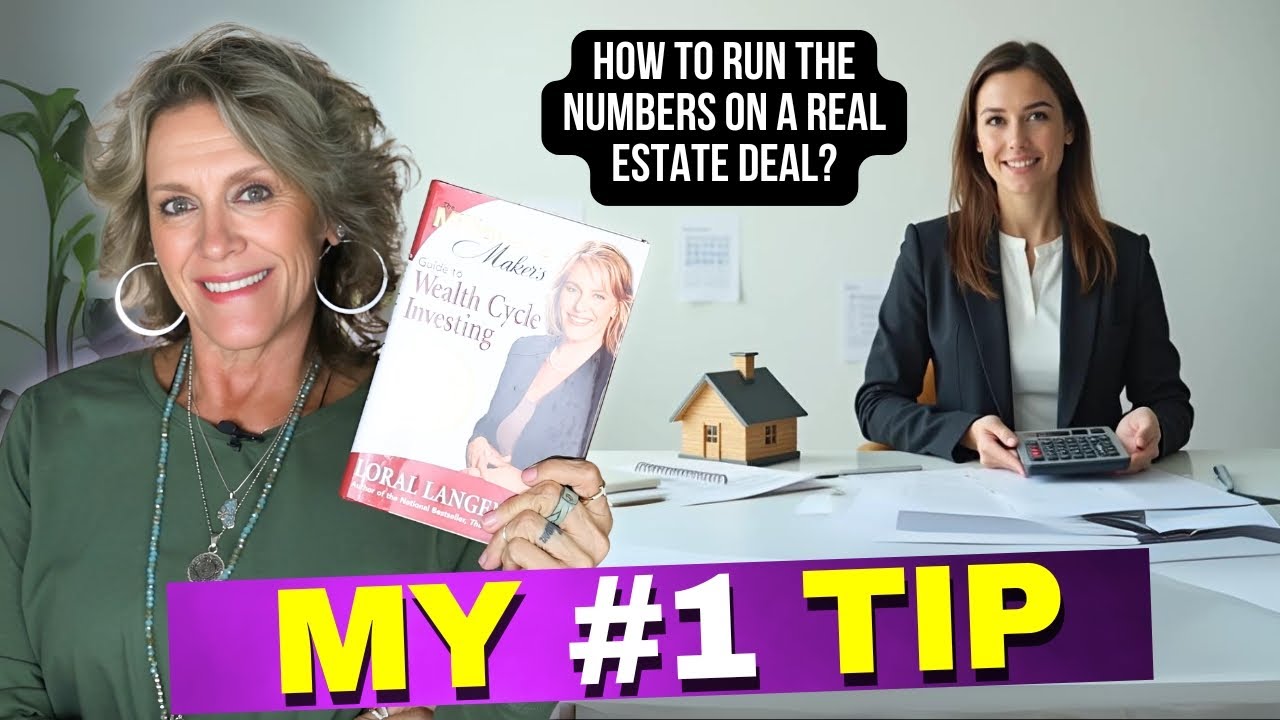
I’m Loral Langemeier. I’ve been a real estate millionaire since 1999. I’ve done over a thousand deals, and I can tell you the single most critical piece of every one of them: running the numbers.
I’m going to call out my fellow women investors on this one first. You love walking into a house and picturing the paint colors, the furniture, the life you’ll live there. Stop. This is not a home. This is an Airbnb, a short-term rental, a duplex, a fourplex. Right now, with interest rates where they are and insurance getting harder and more expensive to secure than ever, the house is a spreadsheet before it’s anything else.
“Creativity is strategic. Emotion is just emotion, and most of you will lose.”
So let’s cover three things: the mistakes that cost investors real money, the five D’s of due diligence from my book The Millionaire Maker’s Guide to Wealth Cycle Investing, and the difference between a creative deal and an emotional one.
Why You Don’t Need an Agent to Invest in Real Estate
One of the biggest misconceptions in real estate is that you have to go through an agent or a broker to invest. That’s false. I’ve never been either one, and I don’t want to be. I have partners and teammates who play those roles, so the cash flow stays in the deal instead of leaking out to a commission.
Every team needs someone running the analytics and the due diligence, someone handling the paperwork, and someone thinking about the exit from day one. Not after you close. Before you buy, you need to know how you’re getting out and when.
Most investors skip this. They also skip the current cost reality. Labor, equipment, and insurance costs all fluctuate year to year. If your spreadsheet is two years old, it’s already lying to you.
The Internet Bathroom Wall: Real Estate Scams to Watch For
The internet has become the bathroom wall of real estate: more people, more scams, more deeds that point to land that doesn’t exist. I’ve had clients come to me on the other side of deals with no property, no land, nothing but a fabricated document.
Here’s the second trap, and I’ll call it a trap, even though real estate is involved. A group convinces you to buy one single-family house, then another, then tells you to buy six in a year across five or six different states. They’ll manage them. They’ll fix them up. Sounds easy.
Ask yourself: have you met the management company? Have you seen the properties? What’s actually happening is they already bought a batch of homes cheaply, often through a pre-foreclosure deal, took their profit, and now they’re selling you the promise of hands-off ownership. If someone promises to handle everything for you in single-family housing, that’s actually a security violation. They’re required to give you choices in management and construction, not a one-stop shop.
If you’re only buying five or six homes, buy them with one or two trusted people. Narrow the risk instead of spreading it across a country you’ll never visit.
The Five D’s of Due Diligence
In The Millionaire Maker’s Guide to Wealth Cycle Investing, I lay out the process that turns perceived risk into real risk you can actually manage. Five steps, in sequence:
- Data. Gather property values, market trends, financials, taxes, and insurance. Check with your county before you buy land. Confirm you can actually build what you want. I’ve had clients buy land, then find out the county wouldn’t approve their plans, or worse, an election flipped the commissioners who had verbally promised approval. If there’s an election cycle in play, that’s a data risk you cannot ignore.
- Discussion. Talk to your agents, your mentor, and your tax advisor. How does this deal fit your state? How is it structured corporately? Is an LLC enough, or do you need a series LLC?
- Discovery. Look at every comparable in the area. Study what your most successful local investors are doing, and study what the ones who are failing are doing too.
- Diagnosis. Numbers don’t lie. People do. Analyze the repair costs, the conditions, and the real investment potential with your team, not your gut.
- Decision. Do the deal or don’t? That’s the whole point of the first four D’s: getting to a decision that isn’t emotional.
Creative Deal vs. Emotional Deal
These two get confused constantly, and they are not the same thing.
Creativity in real estate means structuring deals in ways most people never consider, using other people’s credit, IRA money, and hard money lending, and using 0% financing as debt arbitrage, and bringing in a group of people to reduce your individual risk and split the due diligence load. Creativity is strategic, negotiated, and documented in writing.
Emotion sounds like this: “It’s so beautiful.” “I love the neighborhood.” You’re not living there. You’re investing there. Keep those two goals separate, or the deal will decide for you.
Start Today
- Pull up your cash-flow spreadsheet and check whether it accounts for 2026 insurance and labor costs, not last year’s numbers.
- Run one deal you’re considering through all five D’s, data through decision, before you make an offer.
- If a group is offering to sell you multiple properties across multiple states and manage them all, ask to see the actual properties and meet the management team before you sign anything.
Running the numbers isn’t the boring part of real estate investing. It’s the part that decides whether you build wealth or hand your money to someone else’s spreadsheet.
Go to AskLoral.com Ask a question, make a request.